Transport Chair vs Wheelchair: Which Should You Choose? (November 2026)
Choose a transport chair for caregiver-assisted trips and a manual wheelchair for independent self-propulsion. Your strength, daily route, transfer needs and storage space should guide the choice.
On this page (10 sections)
- Transport chair vs wheelchair: what is the key difference?
- Which should you choose for assisted transport?
- When is a manual wheelchair the better choice?
- How do wheels change the daily experience?
- Which chair is easier to transfer into?
- Which transport chair suits a heavier user?
- How do the 4 transport chairs compare?
- What should you check before buying?
- Can a transport chair replace a manual wheelchair?
- Final choice: transport chair vs wheelchair
Choose a transport chair for caregiver-assisted trips and a manual wheelchair for independent self-propulsion. In this transport chair vs wheelchair comparison, the right choice depends on who will push, how far you travel and how the chair will be stored.
A transport chair is usually the better fit for appointments, errands and vehicle travel with a companion. A manual wheelchair is usually better for someone who can use hand rims and needs control over everyday movement.
This guide compares assisted transport with independent propulsion, including lightweight wheelchair vs transport chair trade-offs, transfers, wheels, brakes and storage.
 Best for compact daily trips
Drive Medical Folding Transport Wheelchair
 Best for brake control
Medline Lightweight Foldable Transport Wheelchair with Handbrakes
Transport chair vs wheelchair: what is the key difference?
A transport chair needs a companion to push, while a manual wheelchair can support self-propulsion. That difference affects independence, caregiver effort, wheel size and the space needed around the chair.
Transport chairs have small wheels and push handles for the person behind the chair. They often fold into a compact shape for a car trunk or closet.
Manual wheelchairs generally use larger rear wheels with hand rims. The seated user can push those rims when strength, balance, reach and coordination allow it, while a companion can also push when needed.
A transport chair can still be the best mobility aid for someone who walks short distances but needs a seat for longer outings. A manual wheelchair can be a better daily option when the user needs to move without waiting for a companion.
For a broader look at fit and features, see our guide to best wheelchairs for adults.
Which should you choose for assisted transport?
Choose a transport chair when another person will provide nearly all propulsion. It suits trips where compact folding, push control and easy transfers matter more than independent movement.
Look for push handles that give the companion a comfortable grip, brakes that can secure the chair during transfers and footrests that move away from the seat. These details make loading, unloading and sitting down easier to manage.
A transport chair also makes sense as a secondary mobility aid. Someone who uses a manual wheelchair at home may still prefer a lighter folding chair for a family outing or a short appointment.
Best transport chairs for caregiver-led trips
The Drive Medical Folding Transport Wheelchair has a steel frame, 8 in front and rear wheels, a 17 in padded nylon seat, padded armrests, swing-away footrests and a fold-flat backrest. Its compact folding frame suits daily trips where a companion handles movement.
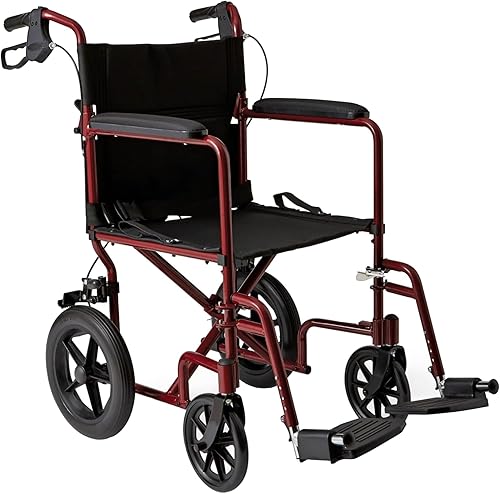
The Medline Lightweight Foldable Transport Wheelchair has an aluminum frame, a 300 lb capacity, hand brakes, rear-wheel manual locking brakes and 12 in rear wheels. Its 19 in wide by 16 in deep seat and swing-away, detachable footrests suit users who want more seat room and easier transfers.
When is a manual wheelchair the better choice?
Choose a manual wheelchair when the user needs to propel the chair or control movement throughout the day. To compare powered mobility, read manual wheelchair vs power wheelchair.
It can reduce dependence on a companion, but it also requires enough upper-body function and a route that supports safe wheelchair use.
Self-propulsion takes more than simply reaching the hand rims. The user needs to start, stop, turn and manage surfaces without losing balance or tiring too quickly.
A manual wheelchair may also suit a caregiver-led routine. Its larger rear wheels can give the companion more control, while the user keeps the option of self-propulsion when conditions allow.
Review the main manual wheelchair types before choosing a frame or wheel layout. The best design depends on how the chair will be used, transported and stored.
Lightweight wheelchair vs transport chair for everyday use
A lightweight wheelchair offers more movement control, while a lightweight transport chair is often easier for a companion to lift and fold. Neither is automatically better for every user.
The Drive Medical Lightweight Expedition Folding Transport Wheelchair weighs 19 lb and supports up to 300 lb. It has an aluminum frame, 12 in rear wheels, curb assist, padded armrests and companion-activated loop lock hand brakes.
The word lightweight does not turn a transport chair into a self-propelled wheelchair. If independent movement is the main need, confirm that the chair has suitable rear wheels and hand rims rather than choosing by carry weight alone.
How do wheels change the daily experience?
Larger rear wheels can help with caregiver control and uneven surfaces, while smaller wheels keep a transport chair compact. Wheel size is one of the clearest differences between these mobility aids.
The Drive Medical Folding Transport Wheelchair uses 8 in wheels at the front and rear. The Medline Lightweight Foldable Transport Wheelchair and Drive Medical Expedition use 12 in rear wheels.
Larger rear wheels can make it easier for a companion to guide the chair over small changes in surface level. They also add to the chair's overall shape, so measure doorways and storage areas.
A manual wheelchair's large rear wheels serve another purpose. Their hand rims give the seated user a way to push, slow and turn the chair.
Don't treat wheel size as a promise that a chair can safely handle every ramp or curb. Follow the chair instructions and use suitable assistance on slopes and uneven ground.
Which chair is easier to transfer into?
A chair with swing-away or detachable footrests makes transfers easier because the front of the seat can be cleared. The user should still transfer with the brakes locked and suitable help when needed.
The Drive Medical Folding Transport Wheelchair has swing-away footrests. The Medline Lightweight Foldable Transport Wheelchair and Medline Durable Folding Steel Transport Wheelchair have swing-away, detachable footrests.
Move the footrests out of the way before standing or sitting. Keep the chair close to the transfer surface, lock the brakes and avoid pulling on removable footrests.
Seat height also affects how easily a person can stand. If foot placement and transfer height are major concerns, read what is a hemi-height wheelchair before choosing a manual chair.
Which transport chair suits a heavier user?
Choose by the chair's stated capacity and the user's total needs, not by frame material alone. The Medline Lightweight Foldable Transport Wheelchair and Drive Medical Expedition each support up to 300 lb, while the Medline Durable Folding Steel Transport Wheelchair supports up to 250 lb.
The Medline Lightweight Foldable Transport Wheelchair combines a 300 lb capacity with a 22 lb product dimension weight, an aluminum frame, 12 in rear wheels and a 19 in wide seat. Those details can suit a user who needs both seat room and easier lifting.
The Drive Medical Expedition combines a 300 lb capacity with a 19 lb stated weight in its product details. Its 12 in rear wheels and curb assist may help the companion handle routine outdoor transitions.
The Medline Durable Folding Steel Transport Wheelchair has a 19 in wide by 16 in deep seat, a steel frame, 8 in wheels and a 250 lb capacity. It weighs 30 lb, so it may suit buyers who value a steel frame more than the lightest carry weight.
Check the user's weight, clothing, cushion and any items carried on the chair before relying on the capacity. If you need more model context, compare our best manual wheelchairs for seniors.
How do the 4 transport chairs compare?
The Drive Medical Folding Transport Wheelchair scores highest for compact daily assisted trips, while the Medline Lightweight Foldable model is strongest for brake control and seat room. The Expedition stands out for low carry weight, and the Medline steel model suits buyers who prefer a steel frame.
| Product | Best for | Frame | Seat | Wheels | Our score |
|---|---|---|---|---|---|
| Drive Medical Folding Transport Wheelchair | compact daily trips | Steel | 17 in padded nylon | 8 in front and rear | 9.7 |
| Medline Lightweight Foldable Transport Wheelchair with Handbrakes | brake control | Aluminum | 19 in wide x 16 in deep | 9.6 | |
| Drive Medical Lightweight Expedition Folding Transport Wheelchair | lifting and travel | 9.5 | |||
| Medline Durable Folding Steel Transport Wheelchair | a steel frame | Steel | 19 in wide x 16 in deep | 9.2 |
Our score weighs specs, features and buyer feedback against the needs of this transport chair vs wheelchair search. It does not mean one chair is right for every user.
The Drive Medical Folding Transport Wheelchair is the most balanced pick for short trips, folding storage and routine transfers. Its padded nylon seat and swing-away footrests add practical comfort without changing its companion-pushed design.
The Medline Lightweight Foldable Transport Wheelchair is a better fit when 12 in rear wheels, hand brakes and a 19 in wide seat matter. Its aluminum frame supports a lighter transport setup.
The Drive Medical Expedition is the easiest of these picks to carry by stated product weight. The 19 lb design, 300 lb capacity and curb assist make it useful for frequent travel with a companion.
The Medline Durable Folding Steel Transport Wheelchair is the heavier choice. Its steel frame, 19 in seat and folding backrest suit routine appointments when carry weight is less important.
What should you check before buying?
Measure the user, the route and the storage space before choosing between a transport chair and wheelchair. A chair that fits the user but cannot pass through the main doorway will not work well day to day.
Measure the narrowest doorway, the space beside the toilet or bed and the vehicle opening. Include room for the companion to stand behind the chair and turn it safely.
Check seat width and depth against the user's clothing and posture. A wider seat can feel less restrictive, but it may also require more clearance through doors.
Review the folded shape and the chair weight before planning car travel. The lightest chair is not automatically the best if the seat, brake layout or footrests do not fit the user's routine.
Consider a cushion only after checking the chair's seat dimensions and the cushion's fit. Our guide to the best wheelchair seat cushion explains what to compare before adding one.
Can a transport chair replace a manual wheelchair?
A transport chair can replace a manual wheelchair for caregiver-led outings, but it cannot replace independent propulsion. Choose the transport chair when the user will be pushed, and choose the manual wheelchair when self-directed movement is a daily need.
Some people need both. A manual wheelchair can support everyday mobility, while a folding transport chair can simplify appointments, travel and situations where a companion will handle the route.
Do not choose based only on the word lightweight. A lightweight transport chair can be easier to lift, but a lightweight wheelchair may offer more control for a user who can propel it.
Power assist can change the effort needed for some manual wheelchair users. Read how to choose power assist for a manual wheelchair if self-propulsion is useful but tiring.
Final choice: transport chair vs wheelchair
Pick a transport chair if a companion will push, transfers and folding storage are your main concerns. Pick a manual wheelchair if independent propulsion and daily control matter more.
For an assisted transport chair, choose the Drive Medical Folding Transport Wheelchair for compact daily trips, the Medline Lightweight Foldable model for brake control and seat room, or the Drive Medical Expedition for low carry weight.
Choose the Medline Durable Folding Steel Transport Wheelchair when a steel frame and 19 in seat matter more than a lighter lift. For a true lightweight wheelchair vs transport chair decision, confirm who will propel the chair before comparing features.
If the main need is caregiver-led movement, the transport chair category fits. If the main need is independent movement, compare manual wheelchair designs and confirm the user can safely propel and control the chair.
Frequently asked questions
What is the difference between a transport chair and a wheelchair?
A transport chair is designed for a companion to push, while a manual wheelchair usually has larger rear wheels and hand rims so the seated user can propel it. Transport chairs often fold compactly, but they give up independent movement for lighter handling and easier assisted trips.
Is a transport chair better than a lightweight wheelchair?
A transport chair is better when a caregiver will handle nearly all movement and vehicle storage matters. A lightweight manual wheelchair is better when the user needs to push with the hand rims or wants more control over everyday movement.
Check the exact chair design before choosing.
Can one person push a transport chair?
Yes, one companion can push a transport chair when the route, chair condition and user weight are suitable. Use the brakes for transfers and stops, and follow the chair instructions for ramps, uneven ground and safe handling.
A transport chair isn't designed for the seated user to propel it independently.
Are transport chairs easier to lift than wheelchairs?
Many transport chairs are easier to lift because they use compact folding frames and smaller wheels, but weight varies by model. The Drive Medical Expedition weighs 19 lb, while the Medline steel transport chair weighs 30 lb.
Compare folded size and carrying needs, not the chair type alone.


