7 Best Aluminum Rollator 6 Casters (November 2026)
The best aluminum rollators with 6 inch wheels include the Drive Medical Aluminum Rollator Walker for everyday walking, the Medline Aluminum Rollator Walker with Seat for a light seat rollator, and the Drive Medical Aluminum Rollator Fold Up for larger casters.
On this page (5 sections)
The best aluminum rollator 6 casters for most daily walkers is the Drive Medical Aluminum Rollator Walker.
It combines 6-inch wheels, a padded seat, adjustable handles, upright folding and a 300 lb capacity.
That balance matters for daily use because you get walking support, a place to sit and rest, and storage for small items in one frame.
We compared aluminum rollator frames by wheel size, weight, capacity, seat details, folding design and adjustment range.
Six-inch casters work well for compact everyday walking, while larger wheels can make more sense when your route includes rougher surfaces.
Weight changes how a rollator feels in daily use. A lighter frame is easier to lift into a car boot or storage cupboard, while a higher capacity can matter more for some users.
Seat height and handle height matter just as much as weight. If the seat is hard to reach or the handles sit too low, you may not want to sit down or push the rollator for long.
Folding design is another practical point to check before you order. A frame that folds flat or stands upright takes less space in a hallway, car or spare room.
It also helps when visitors are coming or when you need to park the rollator beside a chair.
Read Types of Rollators Explained: The Basics if you are still deciding between a rollator, a standard walker and other mobility aids.
That guide helps you think about brakes, seats and wheels before you focus on one model.
In this roundup, the top picks keep 6-inch wheels for compact movement. The last picks show when 7.5-inch or 8-inch wheels may suit your route or height better.
Use the measurements in each section to check fit, storage and lifting ease. Stay within the stated capacity, including bags and personal items you carry.
Our picks at a glance
-
1

-
2
 Best for a light seat rollator
Medline Aluminum Rollator Walker with Seat
9.6/10 our score
See it on Amazon -
3
- 4
 Check it
Medline Superlight Folding Aluminum Mobility Rollator Walker
Best for low lifting weight - 5
 Check it
Dynarex DynaGo Quad 6 Foldable Aluminum Rollator
Best for compact folding - 6
 Check it
Probasics Junior Aluminum Rollator with 6 Inch
Best for a lower seat - 7
 Check it
RollisRoll Walkers for Seniors Taller 5.3~7ft
Best for taller users
The best aluminum rollator 6 casters for daily use
The best aluminum rollator 6 casters should match your weight, walking surface, seat height and storage needs. The top four choices here focus on 6-inch wheels, while the final three show when a different wheel size or frame layout may be better.
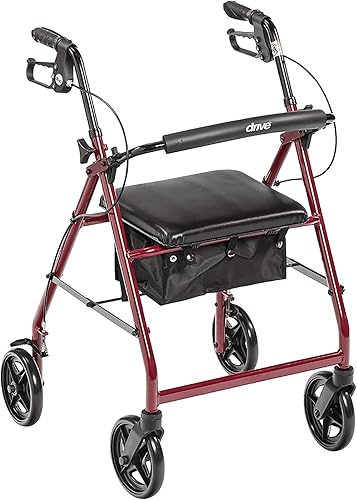
Drive Medical Aluminum Rollator Walker: Best for everyday walking
- 6-inch wheels
- Padded seat
- 300 lb capacity
- Adjustable handles
- One-handed folding
A balanced everyday rollator with a padded seat, storage pouch, adjustable handles and a frame that folds upright for storage.
Pros
- 300 lb capacity
- Padded seat and hinged backrest
- Folds upright
Cons
- Heavier than the lightest picks
- 6-inch wheels are smaller than the larger-caster options
The Drive Medical Aluminum Rollator Walker is the strongest all-around pick for daily walking.
Its 6-inch wheels, padded seat and storage pouch cover the needs of someone who wants walking support with a place to rest.
The aluminum frame weighs 15.6 lb and supports up to 300 lb.
That weight sits in the middle of this group, so it suits users who want capacity without the heaviest frame.
Adjustable handles help you set the grip to your height, while the hinged backrest folds up or down.
The backrest can support you when seated, or fold away when you do not need that extra support.
The side-to-side design folds with one hand and lets the rollator stand upright when folded.
That can make parking it beside a chair or storing it in a closet easier, because it does not need to lie flat on the floor.
The storage pouch keeps small personal items close at hand during walks or errands.
That is useful for keys, a phone or glasses, though you should keep the load within the stated capacity.
Choose this model if you want a balanced mix of capacity, seating and storage.
Its 6-inch wheels suit compact everyday use, but users who regularly cross rough ground may prefer a larger caster.
Set up the handles before your first walk and check that the brakes hold firmly before sitting down.
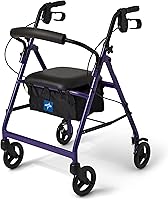
Medline Aluminum Rollator Walker with Seat: Best for a light seat rollator
- 6-inch wheels
- 14 lb frame
- 250 lb capacity
- 12 x 12 in padded seat
- 31 to 35 in handle height
This purple aluminum rollator keeps the frame light while adding a padded seat, backrest, storage and adjustable handles.
Pros
- 14 lb weight
- Padded seat and backrest
- Easy-grip brake handles
Cons
- Lower capacity than the top Drive Medical pick
- Seat is 12 x 12 in
The Medline Aluminum Rollator Walker with Seat is a good choice when a light 14 lb frame matters.
It supports up to 250 lb and has 6-inch wheels, a 12 x 12 in padded seat and a padded backrest.
The purple aluminum frame is a change from the more common dark finishes.
That colour will not suit everyone, but it does make the rollator easier to spot in a room.
The handles adjust from 31 to 35 inches, which helps you find a grip height that keeps your arms comfortable.
Push the ergonomic handles up to brake, then push them down to lock the wheels when sitting or standing.
That simple action is useful when you want to sit down at a bench or stand up again with more confidence.
Under-seat storage keeps small personal items with you during a walk.
The foldable aluminum frame is useful when the rollator needs to go into storage or transport.
Choose Medline when you want a lighter seat rollator and your weight is within the 250 lb capacity.
If you need more capacity, the top Drive Medical model is the better match.
Check the seat size too, because a 12 x 12 in seat may feel small to some users.
Measure your doorway and storage space before ordering, and test the brake action once the rollator arrives.
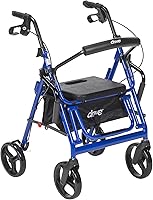
Drive Medical Aluminum Rollator Fold Up: Best for larger casters
- 7.5-inch casters
- 300 lb capacity
- Padded seat
- Removable back support
- One-handed folding
Choose this Drive Medical model when you want an aluminum rollator with a seat and larger 7.5-inch casters for indoor and outdoor use.
Pros
- 7.5-inch wheels
- 300 lb capacity
- Removable back support
Cons
- Not a 6-inch caster model
- Larger wheels may take more room during storage
The Drive Medical Aluminum Rollator Fold Up is the best choice here for larger casters.
Its 7.5-inch wheels are not 6-inch casters, but they give this aluminum rollator a different fit for buyers who want more wheel size.
Larger wheels can roll over small changes in surface with less effort than smaller wheels.
That can help on paths, forecourts or uneven paving, although very rough ground still needs care.
The frame weighs 14 lb and supports up to 300 lb.
You get a lighter frame than the top Drive Medical pick, with the same stated capacity.
It includes a padded seat, storage pouch and removable hinged back support.
The back support can fold up or down, or be removed, depending on how you want to sit.
The handles adjust with an easy-turn lever, so you can set the height without tools.
That helps if more than one person uses the rollator at home.
Its side-to-side folding design works with one hand and allows the rollator to stand upright while folded.
That makes parking and storage simpler, and it can suit users who find flat folding awkward.
Choose this model when wheel size matters more than matching a 6-inch search term.
It may also suit routes that move between indoor and outdoor surfaces, though you should still consider the condition of those surfaces.
Medline Superlight Folding Aluminum Mobility Rollator Walker: Best for low lifting weight
- 6-inch wheels
- 12.6 lb frame
- 250 lb capacity
- Adjustable arms and seat
- 4 ft 11 in to 6 ft 4 in fit
The lightest pick here has adjustable arms and seat, a padded seat and backrest, a storage bag and a compact folding design.
Pros
- 12.6 lb weight
- Adjustable seat and arms
- Wide stated height range
Cons
- 250 lb capacity
- Smaller 6-inch wheels
The Medline Superlight Folding Aluminum Mobility Rollator Walker is the easiest pick to lift.
It weighs 12.6 lb, supports up to 250 lb and uses 6-inch wheels.
That low weight is helpful if you lift the rollator into a car or store it on a shelf.
Its arms and seat adjust for users from 4 ft 11 in to 6 ft 4 in.
The overall height adjusts from 29 to 36 inches, and the seat adjusts from 18 to 23 inches.
That wide range covers many adults, but you should still check your own handle height before ordering.
The padded seat, backrest and under-seat storage bag add rest and carrying space.
A storage bag under the seat keeps items out of the way while you walk.
Easy-grip brakes and a compact folding design help with everyday use and transport.
The brakes are designed to be easy to grip, which can help users with weaker hands.
Choose this model if lifting the rollator into storage or a vehicle is a central concern.
Check the 250 lb capacity before choosing it for a heavier user.
Also check the 6-inch wheels if your route includes rough ground, because smaller wheels feel the surface more.
Dynarex DynaGo Quad 6 Foldable Aluminum Rollator: Best for compact folding
- 6-inch wheels
- About 12 lb
- 300 lb capacity
- 24 in open width
- 6.9 in folded width
The DynaGo Quad 6 focuses on a narrow folded profile, locking wheels, adjustable handlebars and a removable water-resistant pouch.
Pros
- 300 lb capacity
- 6.9 in folded width
- Removable pouch
Cons
- Handle height range is not stated
- Color information differs between product name and description
The Dynarex DynaGo Quad 6 is a compact folding option with 6-inch wheels and a 300 lb capacity.
It is about 12 lb, measures 24 inches wide when open and folds to 6.9 inches wide.
That narrow folded width is the main appeal for users with tight storage space.
Height-adjustable handlebars, locking wheels and a grip-operated braking system support daily walking.
Locking wheels help keep the rollator still when you sit down or stand up.
The removable water-resistant nylon pouch gives you a place for personal items.
A water-resistant pouch can help if you walk in light rain or carry a drinks bottle.
The frame and seat can be cleaned with simple wipes, and the pouch can be removed for cleaning.
That matters if the rollator is used often indoors and outdoors, where dust and dirt build up.
Choose this model when folded width is a major storage concern.
Before buying, confirm that its available handle height suits you because a specific adjustment range is not stated here.
Also measure your doorway, because the open width is 24 inches and may be tight in some homes.
Probasics Junior Aluminum Rollator with 6 Inch: Best for a lower seat
- 6-inch wheels
- 12 lb frame
- 250 lb capacity
- 19 in seat height
- 29 to 34 in height range
The ProBasics Junior gives you a 19-inch seat height, 6-inch wheels, a padded seat and a fold-flat aluminum design.
Pros
- 19 in seat height
- 12 lb weight
- Fold-flat design
Cons
- 250 lb capacity
- Junior dimensions may not suit every adult
The Probasics Junior Aluminum Rollator with 6 Inch is the best fit for users who need a lower seat.
Its seat-to-floor height is 19 inches, with a seat measuring 13.5 in wide by 13 in deep.
A lower seat can make sitting down and standing up easier for some users.
The 12 lb aluminum rollator supports up to 250 lb.
That low weight makes it easier to lift, but the capacity is lower than the 300 lb models.
Its height adjusts from 29 to 34 inches, and the padded backrest can fold up or down or be removed.
The 29 to 34-inch range suits shorter users in particular, so check your own measurements first.
A nylon pouch and a zippered pouch under the seat provide two storage areas.
The zippered pouch under the seat adds privacy for small items you do not want on show.
The 6-inch non-marring wheels and soft-grip tires are designed for indoor and outdoor use.
Non-marring wheels can help protect hard floors at home.
Choose this model when the 19-inch seat height and 29 to 34-inch height range fit your body.
The Junior design may not suit every adult, so compare those measurements before ordering.
RollisRoll Walkers for Seniors Taller 5.3~7ft: Best for taller users
- 8-inch rubber wheels
- 350 lb capacity
- 33 to 39 in handle height
- 22 to 25 in seat height
- 5.3 to 7 ft height range
This reinforced aluminum rollator is for taller users who need higher handles, a higher seat and larger wheels rather than a compact 6-inch caster.
Pros
- 350 lb capacity
- Fits users from 5.3 to 7 ft
- 8-inch puncture-resistant rubber wheels
Cons
- Heaviest pick here
- Not a 6-inch wheel model
The RollisRoll Walkers for Seniors Taller 5.3~7ft is the best alternative for taller users.
It has an aluminum alloy frame, 8-inch puncture-resistant rubber wheels, a 350 lb capacity and handle height from 33 to 39 inches.
The larger wheels and higher handles make this a different choice from the compact 6-inch caster models.
The seat adjusts from 22 to 25 inches, and the stated height range is 5.3 to 7 ft.
That makes it a different type of choice from the compact 6-inch caster models, because shorter users may find the seat too high.
The 17.4 lb rollator folds in about 3 seconds and includes a removable cup holder, large storage bag and walking stick holder.
A cup holder and cane holder can be handy on longer walks, though they add to the overall size.
Reflective strips appear on the wheels and storage bag, which can help visibility in low light.
Choose RollisRoll when tall-user fit, capacity and larger wheels matter more than low lifting weight.
It is the heaviest model here, so check whether you can lift 17.4 lb comfortably.
Also check your storage space and doorway width, because larger wheels and a taller frame take more room.
How do 6-inch casters affect daily walking?
Six-inch casters keep an aluminum rollator relatively compact and suit smooth indoor floors, sidewalks and many everyday walking routes.
They are also common on lighter designs with folding frames and seats.
In a home, that compact size can make it easier to turn in a hallway or park by a chair.
On a smooth pavement, 6-inch wheels can feel steady and responsive.
The trade-off is clearance. Larger wheels can be easier to manage over uneven ground, thresholds or rough paths, but they may add size or change how the rollator fits in storage.
Small lips at doorways or kerbs can catch a smaller wheel and need a little more push.
That does not make 6-inch wheels wrong, but it does mean your route matters.
Think about where you walk most often, not just where you walk once in a while.
If most trips are indoors, to a local shop or on smooth paths, 6-inch wheels may be ideal.
If your route includes grass, gravel or broken pavement, larger wheels may reduce effort.
The Drive Medical 7.5-inch model and RollisRoll 8-inch model show the alternatives in this group.
Those larger wheels suit different routes, but they also suit different body heights and storage spaces.
If most of your walking is inside, a 6-inch rollator may be easier to position in rooms and hallways.
It may also fold to a smaller profile, which helps in flats or smaller homes.
Wheel size should not be the only factor you check. Seat height, handle height, weight and capacity all affect comfort and safety.
A 6-inch rollator with the right fit may feel better than a larger wheel model that is too tall or too heavy.
Check the surface, the doorway and the storage space before you decide.
That simple check helps you match the wheels to your daily walking, rather than to a search term.
How should you choose between an aluminum rollator and a walker with wheels?
An aluminum rollator usually adds a seat, brakes and storage to the basic rolling support.
A walker with wheels may have a simpler layout, so compare the equipment you need before choosing by material alone.
Aluminum refers to the frame material, not to how the rollator works.
A rollator has wheels that roll with you, plus brakes you can use when you want to slow down or stay still.
That brake control is a key difference from a basic wheeled walker.
With a rollator, you can often sit on the seat, lock the brakes and rest for a while.
That makes longer walks more manageable, especially on errands or in parks.
Our guide to Walker with Wheels vs Rollator: The Basics explains the main difference.
It is worth reading if you are not sure which type suits your balance and walking strength.
If you want to understand why some people choose three wheels for tighter spaces, read What Is a Three Wheel Rollator Good For?.
A three-wheel design can feel more manoeuvrable in smaller rooms.
For a four-wheel model with a seat, compare Best Drive Medical Four Wheel Rollators, Best NOVA Four Wheel Rollators with Seats and Best Four Wheel Rollators with Seats.
Those guides help you compare seat, storage and folding designs across different brands.
Think about your home layout as well as your outdoor routes. Doorway width, thresholds and room size can affect which design feels easiest to use every day.
Also think about how you will store the rollator when it is not in use. A folding frame that stands upright or folds flat can save space in a hallway or cupboard.
Check the weight too, especially if you need to lift it into a car.
The right choice matches your walking, sitting and storing needs, not just the frame material.
What should you check before using an aluminum rollator?
Set the handles and seat so the rollator fits your body before relying on it for regular walking.
Keep all four wheels on the ground, use the brakes when sitting or standing and stay within the stated weight capacity.
A good handle height should let you hold the grips without hunching your shoulders.
If the handles are too low, you may lean forward more than is comfortable.
If they are too high, your arms may feel tense and steering can suffer.
Measure from the floor to your wrist crease when standing upright, and compare that with the handle range for your model.
Check that the folding frame is fully open before walking.
A frame that is not fully open can feel unstable, even if it looks secure at a glance.
If the rollator has a storage pouch, keep its load within the overall capacity and avoid carrying anything that makes steering difficult.
Heavy bags can pull the rollator to one side or make it harder to brake.
Keep personal items light, and spread the load where the design allows.
Inspect wheels, handles, seat hardware and brake action from time to time.
Look for loose fittings, worn tyres or grips that feel slippery.
Clean the frame and seat with simple wipes when needed, following the instructions for the exact model.
Remove dirt from the wheels if it builds up, because it can affect rolling and braking.
Store the rollator in a dry place where it will not be knocked over.
That helps protect the frame, seat and storage pouch between uses.
Before a longer walk, do a quick check of the brakes and folding locks.
That short routine can make daily use safer and more comfortable.
Which aluminum rollator is right for you?
Pick the Drive Medical Aluminum Rollator Walker if you want the best balance of 6-inch wheels, a padded seat, storage and a 300 lb capacity.
Pick the Medline Superlight if low lifting weight matters most.
Its 12.6 lb frame is the lightest here, which helps with lifting and storage.
Choose the ProBasics Junior for its 19-inch seat, or the Dynarex DynaGo Quad 6 when folded width matters.
The Dynarex folds to 6.9 inches wide, which can help in tighter homes.
Move to the Drive Medical 7.5-inch or RollisRoll 8-inch design when larger wheels better match your route or height.
Larger wheels can help on uneven ground, while the RollisRoll also suits taller users.
If you want a lighter 6-inch model with a 250 lb capacity, the Medline in part 3 is also worth checking.
Our score weighs specs, features and buyer feedback against what you are shopping for.
That means a higher score does not always mean the best fit for your body or home.
Measure your doors, storage space, seat height and handle height before choosing an aluminum rollator.
Those measurements will quickly narrow the list to models that suit you.
Check the stated capacity too, and include anything you plan to carry in the pouch or bag.
Then compare folding size and lifting weight against your storage and transport needs.
A rollator that fits your route, your height and your home will be easier to use every day.
Our top 3 picks at a glance
-
1
-
2
Best for a light seat rollator
Medline Aluminum Rollator Walker with Seat
9.6/10 our score
See it on Amazon -
3
Frequently asked questions
What is the best aluminum rollator with 6-inch casters?
The Drive Medical Aluminum Rollator Walker is the strongest overall match because it combines 6-inch wheels, a padded seat, adjustable handles, a storage pouch and a 300 lb capacity. The Medline Superlight is easier to lift, while the ProBasics Junior has a lower 19-inch seat.
Are 6-inch wheels good for an aluminum rollator?
Six-inch wheels suit everyday indoor walking and many outdoor paths. They also keep the rollator's overall design compact.
Larger wheels may be easier over rough ground, so compare the 7.5-inch Drive Medical and 8-inch RollisRoll models if surface changes are common.
How much weight can these aluminum rollators hold?
The listed capacities range from 250 to 350 lb. Drive Medical's 6-inch model and Dynarex's DynaGo Quad 6 support up to 300 lb, while RollisRoll lists 350 lb.
Stay within the stated capacity, including anything carried in the storage area.
What should you measure before buying a rollator?
Measure doorway width, storage space, seat height and the user's handle height. The Dynarex DynaGo Quad 6 is 24 inches wide when open, while the ProBasics Junior has a 19-inch seat height and the Medline Superlight adjusts from 29 to 36 inches overall.