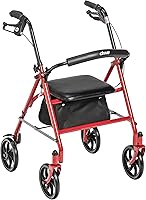
6 Best Small Walkers for Seniors (November 2026)
The best small walkers for seniors include the Graham-Field Lumex Walkabout Junior Rollator for petite users who need a seat, the KMINA Narrow Walker for Small Spaces for narrow rolling support, and the DELOG Narrow Walkers for Seniors for lightweight standard support.
On this page (6 sections)
The best small walker for seniors overall is the Graham-Field Lumex Walkabout Junior Rollator. Its 20 in width, 11.5 lb weight, adjustable handgrips and padded seat make it a strong fit for smaller adults who need support at home or while traveling.
That combination matters because petite users often struggle with frames built for taller people. A handle that sits too high can change posture and make each step feel harder.
The Lumex handgrips adjust from 27.5 to 32 in high. That range lets shorter users keep their elbows at a comfortable angle while standing upright.
The padded seat sits at 18.5 in high and measures 12 x 12 in. It gives you a clear place to rest during longer trips around the house or while out.
An under-seat basket adds practical storage for small personal items. You can keep essentials within reach without trying to carry them in your hands.
The 6 in wheels are made for smooth rolling indoors and outdoors. Larger wheels can help with thresholds and uneven paths better than very small wheels.
Large handgrips and a lock-in-place brake help with control. The parking feature is meant to stop accidental rolling while you sit down.
The stated support limit is 300 lb. That figure should be checked against the user's weight before you choose this model.
At 20 in wide, the frame is designed for narrow doorways and tight rooms. It can also suit travel where space in a car or ship is limited.
This is still a rollator, not a basic lifting walker. The user needs enough hand strength and coordination to use the brakes safely.
The right choice changes if you need a basic walker, one-hand support, a tray or a higher weight capacity. The DELOG is the lightest standard walker, while the Vive Hemi Walker is the narrowest and lightest one-hand option in this group.
A standard walker may suit short transfers where close support matters most. A rollator may suit longer walks where you want wheels and rests.
If you are still learning the terminology, start with What Is a Compact Rollator? What to Know.
A rollator normally has wheels and hand brakes, while a standard walker usually depends more on lifting or stepping the frame.
Those terms affect how you move, turn and stop. They also affect whether you need a seat, storage or a simpler frame.
Width alone should not decide the purchase. You also need to check handle height, weight, support and daily space.
Measure doorways, hallways and turning areas before you order. Then match the frame type to the way the user moves each day.
For many smaller adults, the Lumex balances rolling support with a seat. For others, a lighter frame without a seat may be a better daily fit.
Our picks at a glance
-
1
 Best for petite users who need a seat
Graham-Field Lumex Walkabout Junior Rollator
9.7/10 our score
See it on Amazon -
2
 Best for narrow rolling support
KMINA Narrow Walker for Small Spaces
9.6/10 our score
See it on Amazon -
3
 Best for lightweight standard support
DELOG Narrow Walkers for Seniors
9.5/10 our score
See it on Amazon
- 4
 Best for one-hand useCheck it
- 5
 Check it
Whlicks Narrow Walkers for Seniors
Best for adjustable width and high support - 6
 Check it
VOCIC Z32 Narrow Walkers for Small Spaces
Best for indoor storage and a tray
The best small walkers for seniors by use
The best small walker for seniors is the one that fits your body and the tightest space you use every day. A compact rollator may be easier to move through a home, while a basic or hemi walker can be lighter and simpler.
Our score weighs the stated dimensions, weight, support, adjustment range, folding design and useful features against the needs behind this search. We compared the product specifications and features supplied for each model, but we did not test these walkers in person.
| Product | Best for | Width | Weight | Handle height | Our score |
|---|---|---|---|---|---|
| Graham-Field Lumex Walkabout Junior Rollator | petite users who need a seat | 20 in | 11.5 lb | 27.5–32 in | 9.7 |
| KMINA Narrow Walker for Small Spaces | narrow rolling support | 22 in | 13.23 lb | 9.6 | |
| DELOG Narrow Walkers for Seniors | lightweight standard support | 18–22 in | 6 lb | 9.5 | |
| Vive Hemi Walker for Seniors | one-hand use | 18 in | 3.85 lb | 9.4 | |
| Whlicks Narrow Walkers for Seniors | adjustable width and high support | 22.4–26.4 in | 6.6 lb | 9.1 | |
| VOCIC Z32 Narrow Walkers for Small Spaces | indoor storage and a tray | 14.5 lb | 8.6 |
Graham-Field Lumex Walkabout Junior Rollator: Best for petite users who need a seat
- 20 in wide
- 11.5 lb
- 300 lb weight capacity
- 18.5 in padded seat
- 6 in wheels
This compact rollator is designed for smaller adults and seniors. It combines a 20 in width, adjustable handgrips, a padded seat and an under-seat basket.
Pros
- Narrow 20 in frame
- Padded seat and basket
- 300 lb support
Cons
- Seat makes it less like a basic folding walker
- Designed around smaller users
The Graham-Field Lumex Walkabout Junior Rollator is the best overall match for a smaller adult who wants a rolling walker with a place to rest. At 20 in wide and 11.5 lb, it is one of the easier rollators here to plan around in narrow rooms and doorways.
The adjustable handgrips run from 27.5 to 32 in high. Its padded seat is 18.5 in high and measures 12 x 12 in, giving you a defined resting spot during errands or trips through the home.
The 6 in wheels are designed for indoor and outdoor surfaces. Large handgrips operate the brakes, and the lock-in-place feature helps keep the rollator from rolling while you sit.
This model supports up to 300 lb and has an under-seat basket. It suits someone who needs more than a basic frame but does not want a full-size rollator built around a larger user.
Choose the Lumex when a petite fit and a seat matter most. If you only need a lightweight frame for short transfers, one of the standard walkers below may be easier to lift.
KMINA Narrow Walker for Small Spaces: Best for narrow rolling support
- 22 in wide
- 13 lb
- 220 lb maximum user weight
- 5 height adjustments
- Foldable aluminum frame
The KMINA gives you a narrow four-wheel frame with a folding system, front wheels with 360° steering, a basket and a tray.
Pros
- Folds for storage
- Five height adjustments
- Basket and tray included
Cons
- 22 in width still needs doorway measurement
- 220 lb maximum user weight
The KMINA Narrow Walker for Small Spaces is a good fit when you want four wheels, a folding frame and storage features in a 22 in design. It weighs 13.23 lb and has a stated maximum user weight of 220 lb.
Five height adjustments help you set the single-axis handlebar for one-handed use. The front wheels provide 360° steering, while the 7 in solid wheels add a larger rolling surface than the standard walkers in this comparison.
A basket with an outside pocket and a tray gives you places to carry small items. The aluminum frame folds by pressing the yellow button, which can make storage easier in a small home.
The braking system is designed to need less force, but the user still needs enough hand control to operate it safely. Measure your narrowest doorway before choosing a 22 in walker.
Choose the KMINA when a narrow rolling frame with a tray and basket is more useful than the smallest possible width. For other compact rollator layouts, see our guide to best narrow rollators for small spaces.
DELOG Narrow Walkers for Seniors: Best for lightweight standard support
- 18–22 in adjustable width
- 6 lb
- 350 lb support
- 30–37 in height adjustment
- Trigger release
The DELOG is the lightest standard walker here and adjusts in both width and height. Its trigger release lets each side operate independently.
Pros
- Only 6 lb
- Width adjusts from 18–22 in
- 350 lb support
Cons
- Standard walker design
- No seat or storage features stated
The DELOG Narrow Walkers for Seniors is the best lightweight choice for buyers who want a standard walker that can adjust in width. It weighs 6 lb and changes from 18 to 22 in wide.
The height adjusts from 30 to 37 in, in 1 in increments. That range gives you more control over the fit than a fixed-width frame, especially when a narrow doorway matters in one room but not another.
The trigger-release design lets you close the walker without removing your hands from the handles. Each side operates independently, which can help when moving through a tight space or standing with the frame.
DELOG states support up to 350 lb. The frame is described as 1.2 mm thick, and the contoured handgrips are designed for comfort during use.
Choose the DELOG when low weight, adjustable width and high stated support matter more than wheels, a seat or storage. If lifting a standard walker is difficult, compare this 6 lb frame with the 3.85 lb Vive.
Vive Hemi Walker for Seniors: Best for one-hand use
- 18 in wide
- 3.85 lb
- 300 lb support
- Foldable
- One-hand design
The Vive Hemi Walker is a compact one-hand walking and stand-assist aid. It folds, adjusts in 1 in increments and arrives pre-assembled.
Pros
- Lightest option here
- 18 in wide
- One-hand maneuverability
Cons
- One-hand design may not suit every user
- No seat or wheels
The Vive Hemi Walker for Seniors is the narrowest and lightest option here. It is 18 in wide, 17 in deep and weighs 3.85 lb, so it is designed for people who need a compact one-hand aid rather than a traditional two-sided walker.
Its cross-brace design, grip handles and non-slip rubber tips provide support while standing or walking. The frame can also be used as a stand-assist device in front of a couch, chair or toilet.
The Vive supports up to 300 lb and folds for transport and storage. Its height adjusts in 1 in increments, and it arrives pre-assembled.
A hemi walker is not the same as a four-wheel rollator. The one-hand layout may suit someone with limited arm mobility, but it should match the user's balance and movement needs.
Choose the Vive when one-hand use and the smallest footprint are the main goals. For a broader comparison of frame types, read Rollator vs Standard Walker: For Seniors.
Whlicks Narrow Walkers for Seniors: Best for adjustable width and high support
- 22.4–26.4 in adjustable width
- 6.6 lb
- 350 lb support
- 5 in front wheels
- 30.3–37.4 in height
Whlicks combines a folding frame with adjustable width, two 5 in front wheels and support up to 350 lb. Its slim-fit setting requires at least 22.5 in of space.
Pros
- 350 lb support
- Adjustable width and height
- Folding frame with front wheels
Cons
- Widest minimum width in this group
- Requires at least 22.5 in of space
The Whlicks Narrow Walkers for Seniors fits buyers who want adjustable width and a high stated support limit. Its width ranges from 22.4 to 26.4 in, and it supports up to 350 lb.
The slim-fit setting requires at least 22.5 in of clear space. That makes doorway measurement especially important, because this is not the narrowest walker in the group even at its minimum setting.
The frame weighs 6.6 lb and folds for storage. Height adjusts from 30.3 to 37.4 in, and the stated user height range is 4 ft 7 in to 6 ft 3 in.
Two 5 in PVC front wheels help it roll over indoor and outdoor surfaces. The frame also has odor-free handgrips and a stated 3-year main-frame warranty, with replacement accessories offered within 1 year.
Choose Whlicks when 350 lb support and adjustable width are more important than fitting through a very narrow doorway. If your opening is near 22 in, measure carefully before ordering.
VOCIC Z32 Narrow Walkers for Small Spaces: Best for indoor storage and a tray
- 22 in maximum width
- 14 lb
- 242 lb maximum load
- 8 in soft PU tires
- Tray and 17.5 L mesh compartment
The VOCIC Z32 is an indoor rollator with a tray, soft tires, a mesh compartment and pockets. Its quick-fold design helps save storage space.
Pros
- Tray with anti-slip pads
- 8 in soft tires
- 17.5 L mesh compartment
Cons
- Heaviest rollator in this group
- 242 lb maximum load
The VOCIC Z32 Narrow Walkers for Small Spaces is the best choice here for indoor storage and carrying items. Its maximum width is 22 in, it weighs 14.5 lb and it has a quick-fold design with a folded size of 37 x 12 x 22 in.
The Z32 includes a tray with silicone anti-slip pads, a 17.5 L mesh compartment and two front and back pockets. Those features can help when you need to move items around an apartment without carrying them by hand.
Its 8 in soft PU tires are designed to be quieter than PVC tires. The front wheels rotate 360°, and the frame has a 1.5 in wide tread with non-slip patterns.
The handle height has 5 adjustment steps, with a maximum height above 41 in. VOCIC states a maximum load capacity of 242 lb, so compare that limit with the user's needs.
Choose the Z32 when a tray, storage and quiet indoor tires matter most. For another tray-focused option, see best indoor rollators with trays.
What should you measure before buying a small walker?
Measure the clear doorway width, hallway width, turning areas and the storage spot before choosing a small walker. The walker must fit through the opening with enough room for you to control it.
A walker that fits straight through a doorway may still be hard to turn inside a bathroom or bedroom. Mark the frame width on the floor with tape if you are unsure about the available space.
Also measure the user's height and compare it with the handle adjustment range. A frame that is too low or too high can make walking less comfortable and harder to control.
For very tight homes, compare the frame widths carefully:
- The Vive Hemi Walker is 18 in wide.
- The DELOG adjusts from 18 to 22 in.
- The Lumex is 20 in wide.
- The KMINA and VOCIC reach 22 in.
- The Whlicks starts at 22.4 in and needs at least 22.5 in of space.
Should you choose a rollator or a standard walker?
Choose a rollator if you want wheels, hand brakes and, in some models, a seat or storage. Choose a standard walker if low weight, close support and a simpler frame are more important.
The Lumex, KMINA and VOCIC are rolling models in this group. The DELOG is a standard folding walker, while the Vive is a one-hand hemi walker.
These are different movement styles, not just different sizes. Your choice should start with how the user walks, turns and rises from a chair.
A rollator moves forward on wheels, so you do not need to lift the whole frame with each step. That can help on longer indoor routes.
It also means the frame can roll away if the brakes are not used correctly. Practice stopping, turning and parking before using it in a busy room.
A standard walker usually moves as you lift or step it forward. That gives close support on both sides and can feel steadier for short moves.
The trade-off is lifting effort and slower progress across a room. A very light frame makes that task easier, but it still requires coordination.
The Lumex adds a padded seat and an under-seat basket. That suits users who need rest breaks during errands or trips through the home.
Its 20 in width and 11.5 lb weight help in narrow spaces. The handle range runs from 27.5 to 32 in for smaller users.
The KMINA is a 22 in rolling frame with a tray and basket. Its 7 in solid wheels and 360 degree front steering support indoor movement.
It weighs 13.23 lb and has a stated maximum user weight of 220 lb. Five height adjustments help with fitting the handle position.
The VOCIC Z32 is also a rollator, with a tray and storage space. Its 8 in soft tires are designed for quiet indoor use.
It weighs 14.5 lb, which is heavier than the other rollators here. Its stated maximum load is 242 lb, so the limit needs careful checking.
The DELOG is a standard walker at 6 lb. Its width adjusts from 18 to 22 in, and its height adjusts from 30 to 37 in.
That makes it flexible for rooms with different doorway widths. Support is stated up to 350 lb, but there is no seat or wheels.
The Vive Hemi Walker is a one-hand design at 18 in wide. It weighs 3.85 lb and supports up to 300 lb.
It suits users who need one-hand mobility or stand assistance near furniture. It is not a replacement for two-sided support for every user.
A rollator may reduce the need to lift the frame, but it also needs brake control and enough room to roll. Read [Is a Rollator Better Than a Walker?
The Basics](/is-a-rollator-better-than-a-walker/) before deciding which style matches your daily movement.
Think about chair rising, bathroom use and turning in small rooms. The best style is the one the user can control safely every day.
What features matter most in small walkers for seniors?
Width matters first when you have narrow doors, but weight, height range, support limit and wheel design also affect daily use. The best small walker for seniors balances all five instead of focusing on width alone.
A seat can help if you need rest breaks, as with the Lumex. A tray and storage can help indoors, as with the KMINA and VOCIC.
A one-hand design can help when two-handed support is not practical, as with the Vive.
Weight matters when the walker must go into a car or be lifted for storage. The Vive weighs 3.85 lb, the DELOG weighs 6 lb and the Whlicks weighs 6.6 lb.
The rollators weigh more because they include rolling hardware and extra features.
Support limits should be treated as a firm selection point. The DELOG and Whlicks state support up to 350 lb, while the Lumex and Vive state 300 lb, the VOCIC states 242 lb and the KMINA states 220 lb.
How do you set up and use a small walker?
Set the handle height so your arms can rest comfortably while you stand upright, then check that every folding lock, wheel and brake works before moving. Use the walker on a clear surface and keep your body inside the frame.
For a folding standard walker, open the frame fully and confirm that the sides lock into place. For a rollator, check the brake cables and test both the rolling brake and the lock before sitting.
Do not use a seat until the rollator is fully stopped and the parking lock is engaged. Keep the wheels and rubber tips clear of dirt, and inspect the frame regularly for loose parts or damage.
If the walker feels unstable, the height is difficult to set or the user cannot control the brakes, ask a qualified health professional to help with fitting and safe use.
Which small walker should you choose?
Choose the Lumex Walkabout Junior if you want the strongest mix of a petite 20 in fit, light rollator frame and padded seat. Choose the DELOG for a 6 lb adjustable-width standard walker, or the Vive Hemi Walker for an 18 in one-hand aid.
Those three choices cover very different needs. Start with the user's body size, balance and the tightest space used each day.
The Lumex suits smaller adults who walk longer routes and need rest breaks. Its handles adjust from 27.5 to 32 in, and its seat is 18.5 in high.
It weighs 11.5 lb and supports up to 300 lb. The 6 in wheels and lock-in-place brakes help with rolling control and sitting.
Choose the DELOG when low weight and doorway flexibility matter most. Its width adjusts from 18 to 22 in, so you can match different rooms.
Its height adjusts from 30 to 37 in in 1 in steps. At 6 lb, it is easier to lift for storage or car travel.
Support is stated up to 350 lb, but it has no seat, wheels or storage. It suits short transfers and close two-sided support.
Choose the Vive Hemi Walker when one-hand use is the main goal. At 18 in wide and 3.85 lb, it has the smallest footprint here.
It supports up to 300 lb and folds for transport. Its height adjusts in 1 in increments, and it arrives pre-assembled.
It can help with standing from a couch, chair or toilet. The one-hand layout must match the user's balance and movement pattern.
The KMINA suits users who want a 22 in folding rollator with a tray and basket. It weighs 13.23 lb and has a stated maximum user weight of 220 lb.
Five height adjustments and 7 in solid wheels support indoor rolling. The front wheels steer at 360 degrees, and the frame folds by pressing a button.
The Whlicks is the better match for adjustable width and 350 lb support. Its width ranges from 22.4 to 26.4 in, and it weighs 6.6 lb.
Its height adjusts from 30.3 to 37.4 in, with a stated user range from 4 ft 7 in to 6 ft 3 in. Two 5 in front wheels help with rolling.
The slim-fit setting needs at least 22.5 in of clear space. That requirement makes it a poor fit for very narrow openings.
The VOCIC Z32 adds the most indoor storage and tray space. Its maximum width is 22 in, and it weighs 14.5 lb.
It includes a tray with anti-slip pads, a 17.5 L mesh compartment and two pockets. The 8 in soft tires are designed for quiet indoor movement.
Its stated maximum load is 242 lb, and its handle exceeds 41 in at the highest setting. Those figures matter for taller users and heavier loads.
Measure the narrowest doorway first, then compare the handle range, support limit and type of movement the user can control. That decision rule will narrow the choices faster than choosing by width alone.
Also check where the walker will fold and store at home. A frame that fits the doorway but not the storage spot will cause daily frustration.
Our top 3 picks at a glance
-
1
Best for petite users who need a seat
Graham-Field Lumex Walkabout Junior Rollator
9.7/10 our score
See it on Amazon -
2
Best for narrow rolling support
KMINA Narrow Walker for Small Spaces
9.6/10 our score
See it on Amazon -
3
Best for lightweight standard support
DELOG Narrow Walkers for Seniors
9.5/10 our score
See it on Amazon
Frequently asked questions
What is the best small walker for seniors?
The Graham-Field Lumex Walkabout Junior Rollator is the best small walker for seniors in this comparison when you want a narrow rolling walker with a seat. It is 20 in wide, weighs 11.5 lb and supports up to 300 lb.
Choose the DELOG if low weight and adjustable width matter more than a seat.
What width is best for a small walker?
The best width depends on your narrowest doorway and the space needed to turn. The Vive Hemi Walker is 18 in wide, the Lumex is 20 in wide and the KMINA and VOCIC reach 22 in.
Measure the doorway opening and hallway corners before choosing.
Are small walkers for seniors safer than larger walkers?
A small walker can be easier to position in narrow rooms, but width alone does not decide safety. The frame must fit the user, remain stable during movement and allow enough room for the feet.
Set the height correctly and ask a health professional for fitting help when needed.
What is the lightest small walker in this comparison?
The Vive Hemi Walker is the lightest option at 3.85 lb. The DELOG follows at 6 lb, while the Whlicks weighs 6.6 lb.
The Vive uses a one-hand design, so compare that layout with the support pattern you need before choosing it.
Can a small walker fit through a 20 inch doorway?
The Vive Hemi Walker is 18 in wide, and the DELOG adjusts from 18 to 22 in, so both may fit a 20 in opening at the right setting. The Lumex is 20 in wide.
Measure the clear opening, not just the door slab, and allow room to move the frame through.