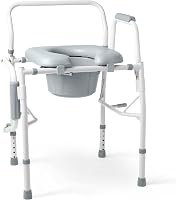
How to Choose a Bedside Commode with Removable Arms
Choose a bedside commode with removable arms by matching the arm mechanism to your transfer method, then confirm seat width, height, weight capacity and replacement-part compatibility. A drop-down arm can help with lateral transfers, while a folding frame may suit storage and transport.
On this page (7 sections)
- How do removable arms help with transfers?
- What should you check in a bedside commode with removable arms?
- Which bedside commode with removable arms fits your setup?
- How do you check replacement arm compatibility?
- How should you use and care for the arm mechanism?
- What other bathroom aids may work with a commode?
- Which bedside commode with removable arms should you choose?
A bedside commode with removable arms is best chosen by transfer method first, then by seat height, usable width, weight capacity and replacement-part fit. A drop-down arm can clear the side for a lateral transfer, while a folding commode can be easier to store between uses.
Measure the bed, wheelchair and bathroom route before you choose. The right frame should give the user enough transfer space without making the seat too wide or difficult to position.
If you are comparing bathroom equipment more broadly, our guide to commode chairs explains how bedside, over-toilet and safety-frame uses differ.
How do removable arms help with transfers?
Removable or drop-down arms help by opening one side of the seat. That side clearance can make a lateral transfer easier for someone moving from a wheelchair or for a caregiver assisting from beside the commode.
A drop-down arm normally moves on a hinge or similar joint and stays attached to the frame. A removable arm may come off the frame instead.
Confirm which action the model uses because “removable arm” and “drop arm” can describe different mechanisms.
Look for a release button, latch or pin that you can operate without forcing the arm. The arm should return to a secure position before the user sits.
Check both sides if transfers may happen from either direction.
The best drop arm bedside commode options can help you compare different arm designs, but your own transfer route still matters more than a general ranking.
What should you check in a bedside commode with removable arms?
Check transfer clearance, seat width, seat height and weight capacity before considering finish or extra features. These measurements determine whether the commode fits the person and the room.
Transfer clearance and arm movement
Measure the space beside the bed, wheelchair or toilet. Lowering an arm is only useful if there is enough room for the user, wheelchair and caregiver to move into position.
Check whether the arm drops straight down, swings away or detaches. Also check where the release control sits.
A mechanism that is easy to reach from the transfer side may be preferable when the user has limited hand strength.
The arm should not become a loose obstacle during a transfer. If it detaches completely, plan where it will go so it cannot be misplaced or left underfoot.
Read our drop arm commode versus bedside commode comparison if you are deciding between a fixed-arm frame and a transfer-focused design.
Seat width and usable space
Compare the seat's usable width rather than relying only on the frame's outside width. A wider seat may give more sitting room, but it also needs more clearance beside the bed and through doorways.
The DMI model below has an extra-wide seat, while the Medline model has a 23 in seat interior width. Use those figures as part of a complete fit check, not as a substitute for measuring the user and the room.
If you need a broader frame, see how to choose a wide drop arm commode. A wide commode may improve sitting room, but it can reduce maneuvering space in a small bedroom.
Seat height and transfer level
Adjustable height lets you bring the commode closer to the bed or wheelchair transfer level. The user's feet should reach the floor, and the seat should not be so low that standing requires excessive effort.
The Drive Medical model has adjustable height settings. Medline gives an 18–22 in seat height range, while DMI gives adjustable legs from 20–24 in.
These ranges are not interchangeable, so compare them with the surfaces already in your home.
Weight capacity and frame fit
Choose a capacity that leaves a clear margin above the user's body weight. The Drive Medical and Medline models support up to 350 lb, while the DMI model supports up to 500 lb.
Capacity alone does not confirm a comfortable fit. Also check the seat width, arm position and space needed for a safe transfer.
Which bedside commode with removable arms fits your setup?
The best match depends on whether you value folding storage, padded seating, extra width or a higher stated weight capacity. These three products cover different priorities.
Drive Medical Folding Bedside Commode
The Drive Medical Folding Bedside Commode suits someone who needs adjustable height, fold-up steel legs and a 350 lb capacity. Its 3-in-1 design can serve as a bedside commode, a raised toilet seat over an existing toilet or a bathroom safety frame.
The powder-coated steel frame has supportive armrests, and the 7.5-quart bucket has a splash shield, carry handle and protective cover. The snap-on seat and lid use a tool-free setup, while push-pin adjustments help set the height.
This model is a practical choice when storage and transport matter. Its title does not identify a drop-down or removable arm mechanism, so verify the arm design if side clearance is the main reason you are shopping.
Medline Drop Arm Commode Chair
The Medline Drop Arm Commode Chair suits wheelchair users and adults who need a padded seat with drop-down arms. The arms lower for lateral transfers, and the chair has an 18–22 in adjustable seat height range.
Its steel construction includes a removable pail, splash guard and clip-on seat. The bucket can be removed when the frame is used as a raised toilet seat over a regular toilet.
The padded seat may be useful when short-term sitting comfort matters. Confirm the arm's lowered position and the available side space before setting it beside a bed or wheelchair.
For setup and placement steps, follow our guide on how to set up a bedside commode.
DMI Drop Arm Portable Toilet Commode
The DMI Drop Arm Portable Toilet Commode suits users who need an extra-wide seat, drop-arm access and a 500 lb capacity. Its adjustable legs range from 20–24 in, and the total dimensions are 29.5 in wide by 20.5 in deep by 29.25 in high.
The drop arms use a release button for sliding access from either side. Its removable 5-liter bucket has a snap-on lid and carry handle, and the frame has non-slip feet.
The extra width can help when a standard seat feels too narrow, but it needs more room beside the bed and along the transfer route. Measure the complete setup before choosing it for a compact bathroom.
How do you check replacement arm compatibility?
Check the brand, model number, attachment points and release hardware before ordering a replacement arm or armrest. Similar-looking commodes may use different pins, brackets or hinge spacing.
Record the model number from the frame or instructions. Then compare the replacement part's mounting points, overall dimensions and locking method with the existing arm.
A bedside commode with a removable arm rest may still require a brand-specific replacement. Do not assume that an arm from another commode will fit because both frames have similar widths.
Also check whether the replacement includes the hardware needed to attach it. If the arm is loose, cracked or fails to lock, stop using that side until the frame is repaired or replaced.
How should you use and care for the arm mechanism?
Keep the arm mechanism clean, dry and fully locked before use. Test the release and locking action without a user seated so you can confirm that the arm moves as expected.
Place the commode on a level surface and keep the feet clear of rugs, cords and other obstacles. Set the height before the transfer, then check that both feet remain stable on the floor.
For a drop-arm commode, lower the arm only when the user is ready to transfer and the receiving surface is positioned. Raise and secure it before the user sits unless the care plan requires another arrangement.
The drop arm commode use guide covers the transfer sequence and common placement points in more detail.
Clean the seat, bucket and arm contact areas according to the product instructions. The Medline seat detaches for cleaning, and the DMI bucket lifts out for emptying and can be rinsed with mild soap and water.
What other bathroom aids may work with a commode?
A commode is only one part of a safe bathroom setup. Choose each aid around the user's transfer path, not as an isolated item.
A shower stool may help if standing in the shower is difficult. Compare options in our guide to the best shower stools for seniors.
A raised toilet seat may be useful when the main problem is the height of an existing toilet. If you use a bidet, read how to choose a raised toilet seat for a bidet before selecting a model.
Which bedside commode with removable arms should you choose?
Choose the Medline if lateral transfers and a padded seat are your main needs. Choose the DMI if you need an extra-wide seat, access from either side and a 500 lb capacity.
Choose the Drive Medical if folding storage, adjustable height and 3-in-1 use matter more than a documented drop-arm mechanism. For any model, confirm the transfer clearance, seat height, locking action and replacement-part path before ordering.
A bedside commode with removable arms should make the transfer more controlled, not add another uncertain step. Measure first, match the mechanism to the user's movement, and keep the arm locked whenever the commode is in use.
Frequently asked questions
What is a bedside commode with removable arms?
A bedside commode with removable arms has an armrest that lowers or moves out of the transfer path. This can give a wheelchair user or caregiver more room to slide across during a lateral transfer.
Check the release method, clearance and locking position before choosing one.
Is a drop arm commode the same as a bedside commode?
A drop arm commode is a type of bedside commode, but not every bedside commode has a moving arm. A standard commode may have fixed armrests, while a drop-arm model is designed to create side access for transfers.
Compare both types in your bathroom and transfer setup.
How high should a bedside commode be?
Set the commode so the user can sit with both feet supported and stand without excessive effort. Adjustable models help you fine-tune the fit, but seat height must also work with the bed, wheelchair or toilet involved in the transfer.
Measure these surfaces before ordering.
Can you replace the arms on a bedside commode?
Replacement compatibility depends on the brand, model number and arm design. Before buying spare arms or armrests, record the commode's model number and compare the attachment points, release hardware and dimensions with the replacement part.